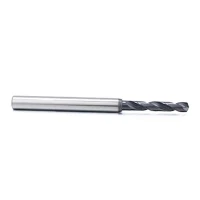
Usage Of CNC Milling Cutters
Oct 25, 2023
Clamping of milling cutters
Most milling cutters used in machining centers adopt the spring clamp set clamping method, and are in a cantilever shape when used. During the milling process, sometimes the milling cutter may gradually protrude from the tool holder, resulting in integrity? The phenomenon of workpiece scrapping due to loss is generally caused by an oil film between the inner hole of the tool holder and the outer diameter of the milling tool handle, resulting in insufficient clamping force. When milling cutters leave the factory, they are usually coated with anti rust oil. If non water-soluble cutting oil is used during cutting, a mist like oil film will also adhere to the inner hole of the tool holder. When the oil film is stored on both the tool holder and the tool holder, it is difficult for the tool holder to firmly grip the tool holder, and the milling cutter becomes extremely loose during processing? Lost. So before clamping the milling cutter, the milling cutter handle and the inner hole of the clamp should be cleaned with cleaning solution, wiped dry, and then clamped.
When the diameter of a milling cutter is large, even if the handle and clamp are clean, it is still possible to occur? In case of a knife loss accident, a knife handle with a flattened notch and corresponding side locking method should be selected.
Another possible issue that may occur after the milling cutter is clamped is that the milling cutter is breaking at the tool clamp port during processing. The reason for this is usually due to the excessive use of the tool clamp and the wear of the tool clamp port into a cone. At this time, a new tool clamp should be replaced.
Vibration of milling cutters
Due to the small gap between the milling cutter and the tool holder, there is a possibility of vibration during the machining process. Vibration can cause uneven cutting of the circular edge of the milling cutter, and increase the cutting expansion compared to the original value, affecting machining accuracy and tool service life. However, if the width of the groove produced by the milling process is exactly small, it is also possible to artificially make the tool vibrate and increase the cutting expansion to obtain the required groove width. However, in this case, the maximum amplitude of the milling cutter should be kept below 0 or 02mm, otherwise bumpy cutting cannot be carried out. The smaller the vibration of the milling cutter during normal processing, the better.
When cutting tool vibration occurs, consideration should be given to reducing the cutting speed and feed speed. If both have been reduced by 40% and there is still significant vibration, consideration should be given to reducing the cutting amount.
If resonance occurs during machining of fragments, the reason may be due to factors such as excessive cutting speed, precisely small feed speed, insufficient tool fragment stiffness, insufficient workpiece clamping force, and the shape or key points of workpiece clamping. In this case, measures such as adjusting cutting amount, adding tool fragment stiffness, and improving feed speed should be taken.