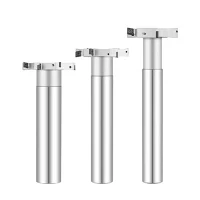
Common Problems With CNC Milling Cutters
Oct 23, 2023
Insufficient precision in size: Solution:
1. Excessive cutting reduces the depth and width during cutting
2. Lack of accuracy in repairing machines or fixtures
3. Lack of rigidity in the machine or fixture changes the machine/fixture or cutting settings
4. The number of blades is too small. Use a multi blade end milling cutter
Milling cutters have developed rapidly, known in the industry as rotary cutting tools, but are only integral hard alloy milling cutters. In fact, more milling cutters are used in hole processing and cavity processing, and most of these milling cutters are equipped with blades!
milling
To understand milling cutters, one must first understand milling knowledge
When optimizing the milling effect, the blade of the milling cutter is another important factor. If there are more than one blade participating in cutting at the same time in any milling process, it is an advantage, but too many blades participating in cutting at the same time is a disadvantage. It is impossible for each cutting edge to cut simultaneously during cutting, and the required power is related to the number of cutting edges participating in cutting, in terms of chip formation process, cutting edge load, and machining results, The position of the milling cutter relative to the workpiece plays an important role. When milling, use a milling cutter that is approximately 30% larger than the cutting width and position the milling cutter close to the center of the workpiece, so the chip thickness does not change much. The thickness of the chips cut in and out is slightly thinner than the cutting thickness when cutting in the center.
To ensure the use of a sufficiently high average chip thickness/feed rate per tooth, it is necessary to correctly determine the number of milling cutter teeth suitable for the process. The tooth pitch of a milling cutter is the distance between the effective cutting edges. According to this value, milling cutters can be divided into three types - dense tooth milling cutters, sparse tooth milling cutters, and extra dense tooth milling cutters.
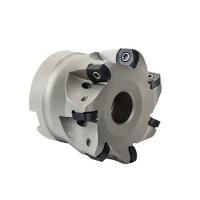
The main deviation angle of the face milling cutter is also related to the thickness of the milling chips. The main deviation angle is the angle between the main cutting edge of the blade and the surface of the workpiece, mainly consisting of 45 degrees, 90 degrees, and circular blades. The direction of cutting force changes greatly with the different main deviation angles: milling cutters with a main deviation angle of 90 degrees mainly generate radial force, which acts on the feed direction, which means that the processed surface will not bear too much pressure, It is relatively reliable for workpieces with weaker milling structures.
A milling cutter with a main deviation angle of 45 degrees has roughly equal radial cutting force and axial force, so the generated pressure is relatively balanced and the requirements for machine power are relatively low. It is particularly suitable for milling short chip material workpieces that produce broken chips.