Call Us: Email: info@cqcnctool.com
enLanguage

End Mill

Your Professional End Mill Supplier


Our goal is to become your true partner in the field of center drill in China. Zhuzuan (Chongqing) CNC Tool Co., Ltd. is a professional enterprise engaged in the research and development, production, and sales of CNC cutting tools. We have a skilled engineering team dedicated to refining every stage, from product development and process improvement to production oversight, ensuring every product delivered meets rigorous quality and performance standards.The price is competitive and the product is quality-assured, which is a good choice for your long-term cooperation.


First 12 Last 1/2

 
Why Choose Us

Product application:

Our company mainly produces milling cutters, drills, reamers, boring cutters, cutting tools, etc. Our products are widely used in automobile, aviation, aerospace, mold, electronics, medical equipment and other industries.

Quality control:

Our company has passed the ISO9001 quality management system. From product design to delivery, each process is strictly carried out in accordance with the requirements of the quality management system to ensure product quality.

Our customization:

Our company can confirm drawings and communicate in advance about tool production design according to your special requirements or OEM & ODM tools, and can also provide a full set of tool processing solutions according to your various processing requirements.


Our services:

In the pre-sales stage, our team of experts will recommend the most suitable products according to the needs of customers and provide detailed technical consultation. During the sales period, we ensure timely delivery and provide installation guidance. For after-sales, we provide long-term technical support, warranty services and spare parts to help customers maximize the use of products and get reliable maintenance during use.


Advantages of End Mill
 

Efficiency: End mills have faster cutting speeds and can significantly improve processing efficiency. Its tool design is reasonable and the cutting process is stable, reducing unnecessary downtime and thus shortening the machining cycle.


High precision: The end mill adopts a vertical processing method, and the workpiece always remains in a fixed position during the cutting process, ensuring high processing accuracy. The cutting edge of the tool is long, which can maintain high precision while allowing greater processing depth.


Stable cutting force: The end mill tool structure is reasonable and the cutting force is evenly distributed and will not be concentrated in a certain part, so the cutting force remains stable. This stability provides better cutting results for the machining process and reduces machining errors caused by cutting force fluctuations.


Strong adaptability: End mills are suitable for processing various complex contours and can be flexibly adjusted according to different shapes and sizes of workpieces. In addition, end mills can also be adapted to the processing needs of different materials by replacing different cutting tools.


High wear resistance: The tool material of the end mill is very wear-resistant and has a long service life. This can not only reduce the frequency of tool replacement and production costs, but also improve production efficiency.


Good flexibility: End mills can achieve different surface quality and thickness processing by adjusting processing parameters, and have strong flexibility and adaptability. This allows the end mill to cope with a variety of different machining requirements during machining.


Types of End Mill
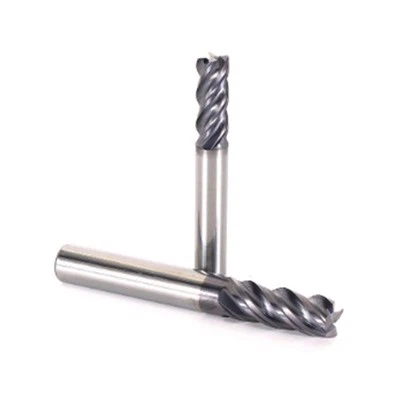
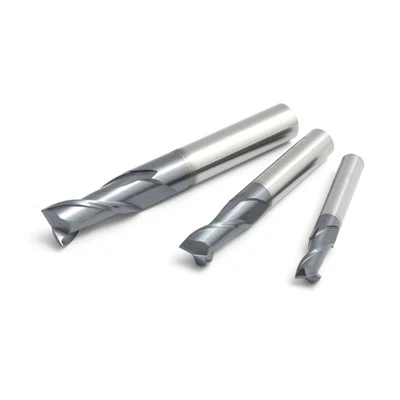
Flat End Mill Cutter
Solid End Mill Cutter
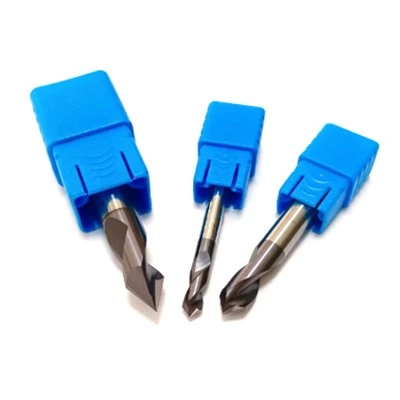
45 and 90 Degree Chamfer End Mill
Nano Coated End Mill

Square end mills: The defining feature for these end mills is a profile that is at 90 degrees. They are suitable for general milling operations.
Keyway end mills: This type of end mill is used for making keyways. The keyways or grooves are common in rotating machinery, for instance, pulleys. You will mostly find this cylindrical tool in the manufacture of components for aerospace and automotive industrial applications.
Ball end mills: These end mills are also called ball nose end mills. The name is derived from the round shape of the cutting edge. The ball end mills are excellent for milling curved surfaces.
Roughing end mills: The end mills are designed for milling out large chunks of material in one pass. They can be either fine or course pitched. Some users call them hog end mills.
Corner radius end mills: These end mills are meant for cutting particular corners. They come with rounded corners.
Roughing and finishing end mills: This end mill group is capable of providing a smooth surface in one pass.
Corner rounding end mills: These end mills are perfect for milling the round surfaces of a workpiece. The tool comes with a specially hardened tip to prevent tool damage by chipping.
Drill mills: These end mills are designed for countersinking and drilling. You want to avoid drilling steel with these end mills.
Tapered end mills: Finally, there are the tapered end mills, which are good at forming channels or tapered holes. They have a tapered end to make this effective.


Specification of End Mill


Coated

Altin

Standard Size

0.2-20mm

Specification

D0.2mm-D20mm

Flutes

2f

Tooth Form

Spiral Tooth

Structure

Indexable Type

Material

Tungsten Steel


Solid End Mill Cutter

Application of End Mill


Mold processing:

Die and mold manufacturing is a specialist field that needs both common and specialized equipment, notably milling cutters, to allow the manufacture of small batches for particular uses.

Heat-resistant alloy machining:

Traditionally, the highest grade tungsten carbide has been used to create end mills. They have sharp teeth as a result of their design, which enables them to polish with extreme accuracy while yet retaining a high level of brightness.

3c processing:

Aluminum and plastics are the two materials most frequently utilized in the 3c sector. Glass, ceramics, and stainless steel have now been included. End mill providers have significant demands as a result of the intense competitiveness in the 3c industry, which necessitates both quick delivery and exceptionally long tool lives.

Aviation industry:

In the aviation sector, milling is widespread. For the components of aircraft wings and engines, complex end mills are employed. In the aviation sector, end mills are now one of the most crucial machining techniques, particularly when working with aluminum alloys.

Metal manufacturing:

Carbide end mills come in a broad range of lengths, diameters, flute counts, and other characteristics. They are selected based on the material they are cutting and the level of surface quality needed for the job.


End Mill Sizes


Fractional

Decimal

Fractional

Decimal

1/64

0.0156

5/16

0.3125

1/32

0.0313

21/64

0.3281

3/64

0.0469

11/32

0.3438

1/16

0.0625

23/64

0.3596

5/64

0.0781

3/8

0.3750

3/32

0.0938

25/64

0.3906

7/64

0.1094

13/32

0.4063

1/8

0.1250

27/64

0.4219

9/64

0.1406

7/16

0.4375

5/32

0.1563

29/64

0.4531

11/64

0.1719

15/32

0.4688

3/16

0.1875

31/64

0.4844

13/64

0.2031

1/2

0.5000

7/32

0.2188

9/16

0.5625

15/64

0.2344

5/8

0.6250

1/4

0.2500

11/16

0.6875

17/64

0.2656

3/4

0.7500

9/32

0.2813

7/8

0.8750

19/64

0.2969

1

1.0000


Carbide Chamfer End Mill

Customizable End Mill


Custom size end mills are, among end mills for milling machines to shave metals or other materials by rotating, a type that has straight flutes with no twists and detailed dimensions of such flutes can be optionally customized according to the machining shape. Since these end mills have the cutting tooth at the bottom and on the side, single bit can cut around outer circumference, drill a boss hole after machining a pilot hole, carry out machining in shapes, etc. The base material is carbide with high frictional resistance; coatings for high heat-resistance or lubricity are available as alterations. Additionally, their shapes include regular-type square, radius, ball, taper, T-slot, chamfering, inner radius, etc., making it possible to select the tool shape that is suitable for machining shape. Their dimensions can be optionally specified, which makes them suitable for special mold machining. After rough machining with carbide end mills or carbide drills, finish machining can be effectively conducted by use of custom size end mills.


Packing and Shipping of End Mill


Packing

Plastic Box

Shipping

Shipped by road, sea, rail


FAQ


Q: What is end milling?

A: End milling is a machining process that uses a rotating cutting tool, called an end mill, to remove material from a workpiece, allowing for the creation of complex shapes and profiles.

Q: What materials can be machined using end milling?

A: End milling is versatile and can be used on various materials, including metals, plastics, and composites.

Q: How does end milling differ from drilling?

A: End milling is designed for creating intricate shapes and contours while drilling primarily focuses on producing holes. End mills have cutting edges on both the tip and sides, allowing for versatile cuts.

Q: What are the benefits of using CNC milling?

A: CNC milling offers high precision, repeatability, and automation in machining, enabling the production of complex parts with tight tolerances.

Q: What types of end mills are available?

A: Common types include square end mills, ball end mills, roughing end mills, and corner radius end mills, each designed for specific applications and cutting needs.

Q: What does an end mill do?

A: End Mills are used for making shapes and holes in a workpiece during milling, profiling, contouring, slotting, counterboring, drilling and reaming applications. They are designed with cutting teeth on the face and edge of the body and can be used to cut a variety of materials in several directions.

Q: What is the difference between a ball mill and an end mill?

A: Flat End Mills get their name from having a flat bottom all the way across, which then comes at 90 degrees onto our sides. Ball Nose Mills have a radius, a hemisphere, or half of a ball (which is where it gets its name from) to give it a rounded end instead.

Q: What is the difference between a slot mill and an end mill?

A: A slot drill is a mixture of a drill and an end mill meaning it can plunge in like a drill then slot across like an end mill. Conversely, an end mill will primarily cut laterally and horizontally. Slot drills will have a flute that comes to the middle and an end mill will have clearance in the centre.

Q: What is the difference between a drill bit and an end mill?

A: End mills come in a variety of types, including ball end, square end, and corner radius, each designed for specific milling applications. Drill Bits: Drill bits are primarily designed for drilling operations, creating cylindrical holes in the workpiece.

We're professional end mill manufacturers and suppliers in China, specialized in providing high quality customized service. We warmly welcome you to wholesale end mill made in China here and get quotation from our factory. Good service and low price are available.

45 and 90 Degree Chamfer End Mill, Flat End Mill Cutter, V Groove Milling Cutter

(0/10)

clearall